
When to Use a Provisional Patent Application (and Avoid Costly Mistakes)
What Is a Provisional Patent Application?
Provisional patent applications are an extremely valuable tool for companies, institutions, and startups of all sizes and funding level. A provisional application is covered by the U.S. patent statute (35 U.S.C. §111(b)). Unlike the traditional non-provisional utility patent application, which requires significant filing fees and is examined for patentability by a patent examiner in the U.S. Patent and Trademark Office (USPTO), a provisional is used specifically as a place holder—to put a foot in the door of the USPTO for an inventive concept. It allows an inventor up to 1-year in which they can claim “patent pending” on the concept. At the one-year anniversary, the applicant must follow through with a full non-provisional application filing, which must conform with all the requirements set forth in 35 U.S.C. § 111-115. Advantageously, the provisional remains secret, so if the applicant decides against filing a non-provisional, the USPTO will maintain what was filed in confidence.
When Should You File a Provisional Patent Application?
The patent statute, particularly 35 U.S.C. § 102 requires that a concept to be patented must be filed upon within 1-year or less than any public disclosure, public use or offer for sale. Without going into the fine nuances of these triggering acts, for most innovators, this means you cannot disclose a concept to someone else who is not covered by a confidential relationship, like an employment/consulting agreement, non-disclosure agreement (NDA), or in Loginov IP’s case, an attorney-client privilege. This means that disclosing the idea to your brother-in-law may actually start that disclosure clock running. More practically, as many contract manufacturers and angel investors will not sign NDAs, you risk losing rights if you don’t have a patent on file before talking to them. Many will, in-fact, expect that a patent is already on file to protect both you and them. The most effective way to protect those critical rights relative quickly is to file a provisional application. It locks in a date for up to 1-year, does not commit the applicant to costly filing fees or follow-on examination costs, and allows some formalities of a patent application to be omitted.
Common Mistakes with Provisional Patent Applications
But…
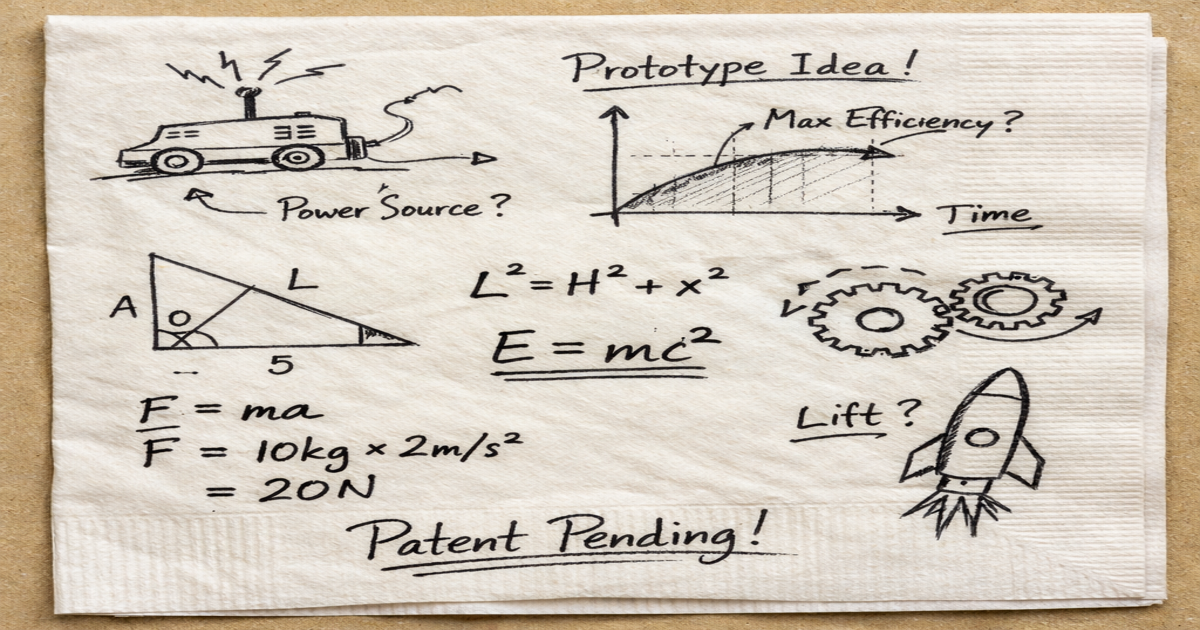
Unfortunately, many applicants think this means you can simply draft a cursory writeup (i.e. a napkin drawing), file it, and call it patent pending. While that may suffice in some rare instances where an invention truly speaks for itself, more often than not, these primitive disclosures open the applicant up to all kinds of headaches downstream.
How Detailed Should a Provisional Patent Application Be?
Referring back to the patent statute, there is a written description requirement under 35 U.S.C. § 112(a) that requires a patent description to speak to those of “skill in the art” so that they can make and use an invention without undue experimentation. This means you need enough detail to teach a technician in the field how to make and use your concept in at least a basic function way. Granted, in some arts, the skill level may be so high, that simply giving a paragraph or two is enough to instruct them. However, for most arts, the description must be much closer to a how-to manual to provide the required enablement for a valid patent. A provisional does not need neat formalized drawings, which certainly save time and money, but some sketches, tied to the description, are generally a must-have. Also, claims, which can often be the most time-consuming part of a patent attorney’s task, are not required, although my and many of my colleagues’ preference is to provide some high level ones as fenceposts around the application’s inventive boundaries—and we aim to make those early posts as inclusive as possible.
Why a “Quick and Cheap” Provisional Can Backfire
So what happens if you file the proverbial napkin drawing? Well, it may mean that you did not really lock in a date on the actual concept. If you later approach a patent law firm, and the non-provisional they prepare is substantially more detailed, questions may be asked by a competitor challenging the patent, an investor vetting it for funding, or even a patent examiner, as to why the detail was not in the provisional to begin with. This is why my personal practice is to try to make the provisional look as much like the final non-provisional to the extent details exist. It avoids a lot of problems down the road, and gives you a document that you can proudly present to potential investors and company officers.
Provisional vs. Non-Provisional Patent Applications
Aside from some cost savings, why use a provisional instead of a non-provisional utility for a first filing? Many of our clients in business and academic circles are in an evolving state of development, but have a critical showing or publication date coming up soon. Filing a provisional on the current concept avoids loss of rights before this key event, but allows them to keep innovating and improving for up to 1-year. The final developments can be placed in the non-provisional, or in an updated provisional within that 1-year window.
Final Thoughts: Should You Use a Provisional Patent Application?
So, will a provisional save you money?
Yes, in the short term, but like most shortcuts, it can be fraught with unknown dangers that shouldn’t be overlooked. A poorly prepared provisional can ultimately cost far more than it saves.
When in doubt, consult a patent attorney.
Disclaimer: This article is provided for general informational purposes only and does not constitute legal advice. The information presented is not a substitute for professional legal counsel and should not be relied upon as such. Patent laws, USPTO procedures, and examination practices are subject to change, and outcomes may vary based on specific facts and circumstances. Readers should consult a qualified patent attorney regarding their individual situation.